Development of novel atomically precise metal nanoclusters for catalytic applications
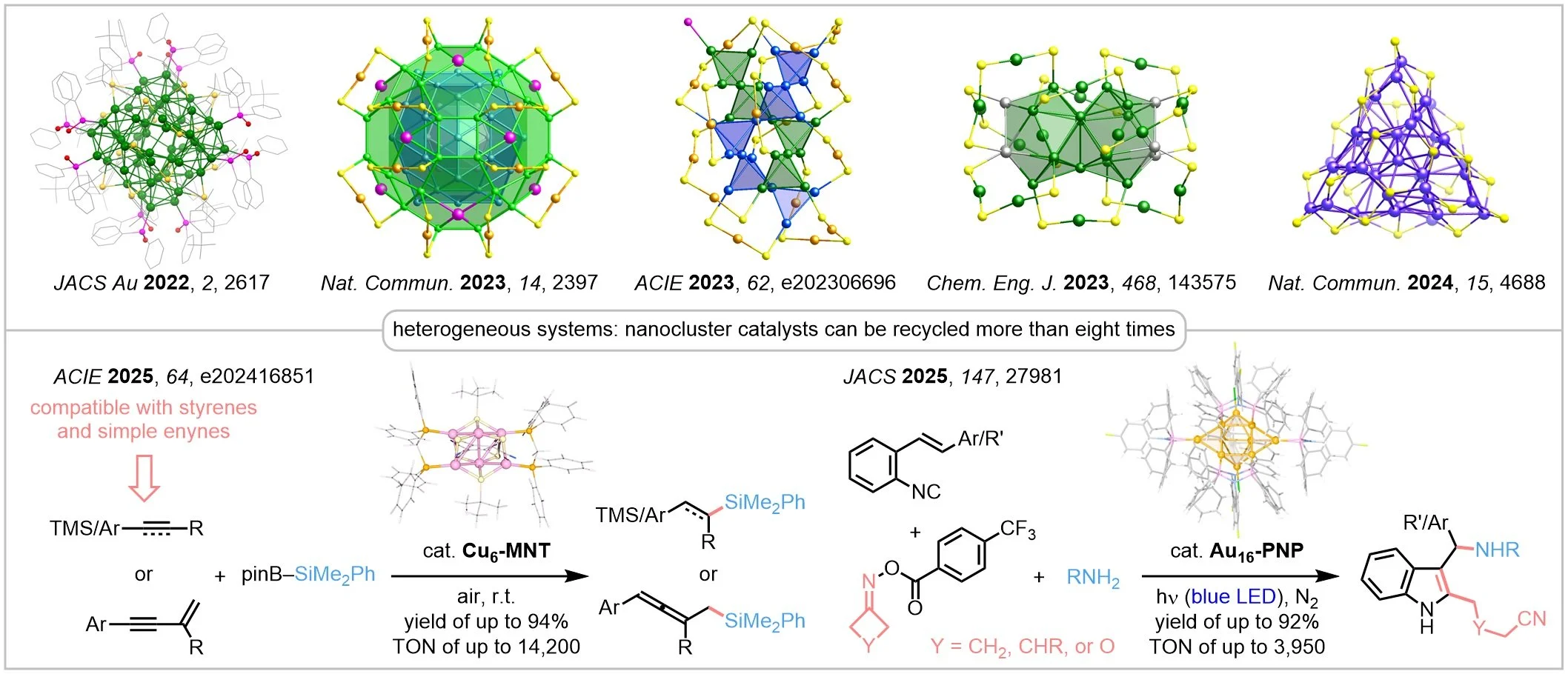
As a newly established research group in nanoscience, we have made significant progress through the development of a two-step synthetic strategy for catalytically active nanoclusters. Beyond creating new catalyst platforms for studying cluster-based electrocatalysis in energy-conversion processes, including the oxygen reduction reaction and carbon dioxide reduction reaction (Key Refs: JACS Au 2022; Nat. Commun. 2023; Angew. Chem. Int. Ed. 2023; Chem. Eng. J. 2023), we have also synthesized several atomically precise metal nanoclusters that display remarkable reactivity in organic synthesis. Notably, an NIR-II-emissive anionic Cu40 nanocluster can activate alkyl halides under blue-LED irradiation, enabling the carbocyanation of styrenes with high turnover numbers (Key Ref: Nat. Commun. 2024). More recently, by simultaneously incorporating thiolate, bidentate phosphine, and maleonitriledithiolate (MNT) ligands, our group constructed Cu6 nanoclusters that combine high stability with exposed active sites and applied them to broad-scope silylprotonation reactions under air. Even at very low catalyst loadings, these clusters showed outstanding activity, delivering a turnover number (TON) of up to 14,200, while retaining their performance over eight recycling runs and demonstrating suitability for gram-scale synthesis (Key Ref: Angew. Chem. Int. Ed. 2025). Compared with conventional copper-complex catalysts, this nanocluster system, for the first time, expanded the substrate scope to include unactivated alkenes and simple enynes. Mechanistic studies revealed that the cooperative interaction between adjacent copper centers in the cluster kernel is crucial for promoting the key migratory insertion step and thereby enabling the broadened substrate scope. In another example of highly efficient and recyclable cluster-based catalysis, we employed nitrogen-linked bisphosphine (PNP) ligands to prepare a series of Johnson-solid Au16 nanoclusters as highly effective heterogeneous photocatalysts for the visible-light-driven three-component radical coupling reaction in Fukuyama indole synthesis. This study represents the first example of activating O-acyl oxime electrophiles in gold photocatalysis (Key Ref: J. Am. Chem. Soc. 2025).