Development of framework-supported transition-metal catalysts with enhanced reactivity and recyclability
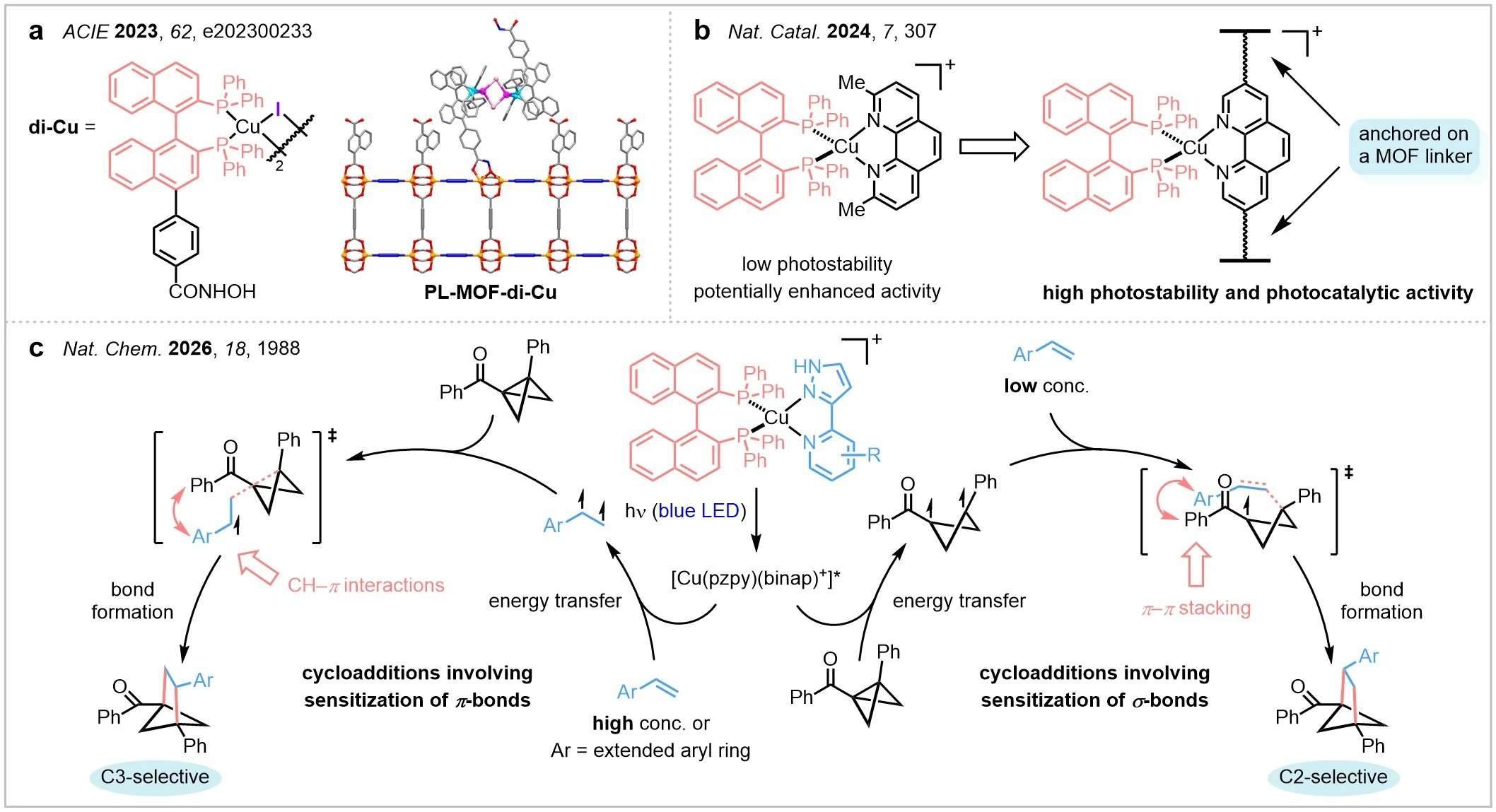
Our group has developed a variety of highly efficient heterogeneous copper catalysts that substantially promote radical coupling and cycloaddition reactions under visible-light irradiation. For example, we immobilized a binap-ligated copper(I) dimer containing a hydroxamic acid linker moiety within a robust and tunable pillared-layer MOF matrix. Compared with its homogeneous counterparts (e.g., di-Cu), the MOF-supported copper complex exhibits superior photocatalytic performance and enables iminyl-radical-mediated transformations at significantly lower copper loadings (Key Ref: Angew. Chem. Int. Ed. 2023). In addition, we prepared a stable heterogeneous copper-based triplet photosensitizer by incorporating a binap-ligated cationic copper(I) complex into the pores of a phenanthroline-functionalized MOF. This system expands the reaction scope beyond that accessible with previous homogeneous catalysts. In particular, crossed [2+2] cycloadditions of styrenes with electron-deficient alkenes provide efficient access to cyclobutane-containing bioactive molecules (Key Ref: Nat. Catal. 2024). Through the careful selection of bidentate nitrogen-donor ligands in copper photosensitizers, we further demonstrated broad tolerance for diverse styrene derivatives in [2π+2σ] cycloadditions, in which initial activation of the alkene double bond affords C3-selective BCH products. At low styrene concentrations, however, initial activation of the BCB core predominates, leading instead to [2σ+2π] cycloadditions with high C2 selectivity (Key Ref: Nat. Chem. 2026).
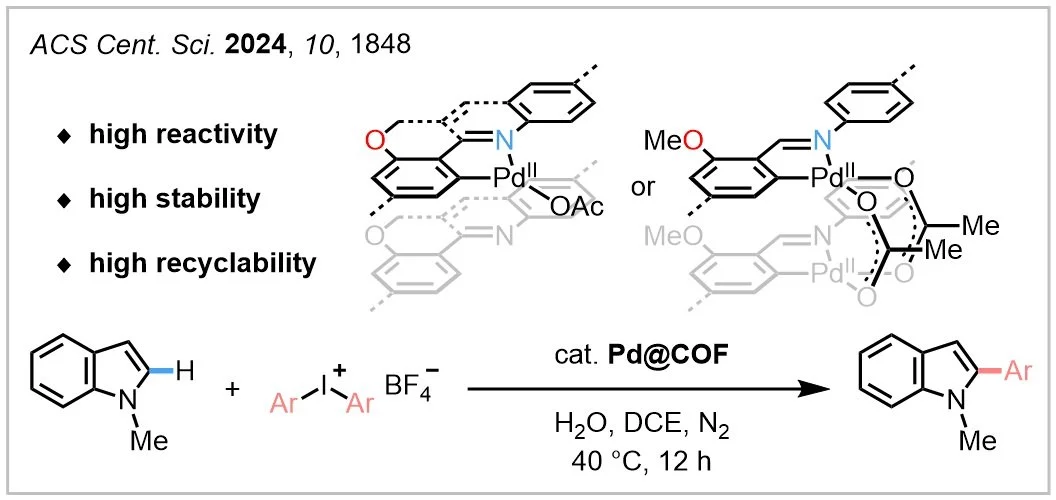
We have synthesized and characterized new quinoline- and imine-linked COF materials that serve as effective solid supports for the preparation of robust heterogeneous palladium catalysts with high stability and reactivity. Beyond generating a catalytically active palladacycle featuring a quinoline moiety on the COF scaffold, we found that post-synthetic metalation of other imine-linked COFs is governed predominantly by in situ cyclopalladation rather than by direct Pd(II) adsorption. Notably, these palladacycle species were employed for the first time to enable C–H activation in a heterogeneous catalytic system. This work provides an alternative and promising strategy for the development of practical C–H activation platforms for green chemical synthesis (Key Ref: ACS Cent. Sci. 2024).